Gas Was Cheap, Roads Were Wide, and Nobody Was Tracking You: The Lost Religion of 1979 Driving
There's a particular smell that 1979 teenagers carried with them everywhere — gasoline, vinyl upholstery baking in July heat, and maybe a little bit of exhaust from a carburetor that probably needed adjusting but absolutely wasn't going to get it. That smell meant something. It meant freedom. It meant you could leave whenever you wanted, go wherever you needed, and nobody — not your parents, not the school, not some app sending push notifications — had any idea where you were.
That's not a bug of 1979 car culture. That's the whole point.
The Moment the Keys Hit Your Palm
If you were a teenager in 1979 and you got your driver's license, the world restructured itself around you almost immediately. The license wasn't a document — it was a declaration. It said, in plain laminated terms, that you were now capable of moving through the physical world under your own power, at your own discretion, on your own timeline.
The car itself didn't have to be beautiful. In fact, the uglier it was, the better the story. A '68 Impala with a cracked dashboard and an AM radio that only pulled in two stations. A '72 Datsun that shook past sixty miles per hour and smelled permanently of someone else's cigarettes. A hand-me-down station wagon that embarrassed you until the moment you realized it fit six people and a cooler. Whatever it was, it was yours, and that changed everything.
Learning to drive in 1979 wasn't a passive experience, either. You didn't glide into a simulator. You didn't watch a YouTube tutorial. You sat in the actual car with an actual adult who may or may not have been gripping the dashboard, and you figured it out. Manual transmissions were common enough that knowing how to drive stick was practically a social requirement. If you stalled at a green light, you stalled. Everybody behind you honked. You learned fast.
Cruising as a Cultural Institution
Cruising — the act of driving slowly up and down a main strip with no destination and every intention — was so ingrained in 1979 American life that most towns had a designated route for it. Friday and Saturday nights, cars would circle the same few blocks for hours. You'd see the same people, wave at the same faces, maybe pull into the same Dairy Queen parking lot three times in one evening.
This sounds pointless until you understand what it actually was: a mobile social network, running entirely on gasoline and eye contact.
You didn't need a plan. You didn't need a reservation. You needed gas money and someone to ride shotgun. The cruising strip was democratic in a way that most social spaces aren't — rich kids, working-class kids, farm kids driving into town, all sharing the same asphalt. The car you drove said something about you, sure, but the act of being out there said something louder: I'm alive, I'm here, and I'm going nowhere in particular at a very deliberate pace.
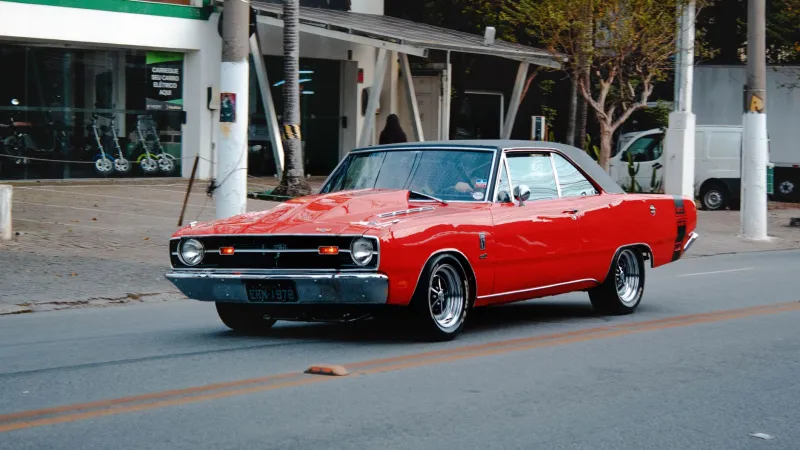
Muscle cars commanded respect on the strip — a Camaro Z28, a Pontiac Firebird, a Dodge Charger with the right exhaust note could make a parking lot go quiet for a second. But a guy who showed up in a beat-up Pinto with a killer eight-track tape player and a good sense of humor? He had his own kind of pull. The culture rewarded personality as much as horsepower.
The Open Road as Emotional Real Estate
Beyond the cruising ritual, the car was the place where the real conversations happened. Therapists charge by the hour for what a long nighttime drive does for free. Something about motion — the road unspooling in the headlights, the radio filling the silence — made honesty easier. Breakups happened in cars. Confessions happened in cars. Best friendships were cemented somewhere between the edge of town and the county line at midnight.
The open road in 1979 had a mythology that Hollywood couldn't stop feeding. The Dukes of Hazzard premiered that year, turning a car — the General Lee — into an actual character. Mad Max hit American theaters and made the road feel dangerous and mythic. Even the anxiety around the ongoing fuel crisis paradoxically deepened the emotional weight of a full tank. When gas felt scarce, a full gauge felt like wealth. A road trip felt like a decision, not just a convenience.
Driving somewhere far — really far, past the suburbs and into the dark countryside — was a teenage rite of passage. You didn't need a destination. The driving was the point. Two hours out, two hours back, radio loud, windows cracked, and the specific freedom of knowing that for this one stretch of time, you existed outside of every system that normally had a claim on you.
What Ride-Shares Actually Took From Us
None of this is an argument against convenience. Uber is fine. It gets you home safe. It's a perfectly reasonable service.
But here's what it doesn't do: it doesn't hand you the keys. It doesn't make you responsible for the machine. It doesn't give you a space that's entirely yours, that smells like you, that has your mixtape in the tape deck and your sunglasses on the dash. It doesn't give you the particular pride of knowing how to parallel park on a hill, or the specific education of being stranded at 2 a.m. with a flat tire and having to figure it out.
The 1979 teenager who drove a dented, semi-reliable car across three counties to see a concert was doing something that required actual competence, actual courage, and actual accountability. The ride-share generation is being shuttled. The 1979 generation was driving.
There's a difference, and it lives somewhere between the steering wheel and the soul.
The Mythology Didn't Lie
Decades later, people who were teenagers in 1979 still talk about their first cars the way other people talk about first loves. They remember the make, the model, the color, the specific sound the engine made when it finally turned over on a cold morning. They remember the roads, the routes, the exits they'd take just to add twenty minutes to a drive they didn't want to end.
That's not nostalgia distorting the memory. That's the memory being accurate about what the experience actually meant.
A full tank of gas in 1979 wasn't just fuel. It was possibility measured in gallons. It was a question — where do you want to go? — that the road was genuinely prepared to answer. All you had to do was drive.