Ring Ring, Baby: How the Landline Ran Your Social Life in 1979
Picture this: It's a Friday night in 1979. You're standing in your kitchen, receiver wedged between your ear and your shoulder, the coiled cord stretched to its absolute limit so you can lean around the corner for a little privacy. You've got three people to call before 8 p.m., a party to coordinate, and exactly zero other options. No texts. No apps. No "seen at 7:42 PM." Just the phone, the cord, and your charm.
That was the deal in 1979, and honestly? It worked.
The landline telephone was, without question, the most underrated social technology of the decade. Sure, the Sony Walkman gets all the glory, and the disco ball takes up most of the nostalgia real estate — but the telephone was the quiet engine running everything. It was the original social network, and it operated on nothing but copper wire, rotary dials, and nerve.
The Phone as Status Symbol
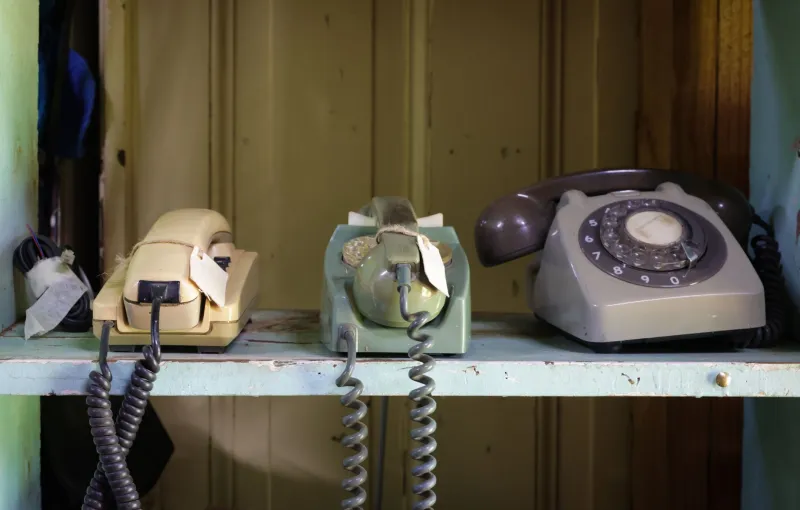
Not all phones were created equal in 1979, and people absolutely knew it. The standard wall-mounted rotary unit in avocado green or harvest gold was the baseline — functional, unfussy, and found in roughly every kitchen in America. But if you had a princess phone in your bedroom? That was a whole different statement.
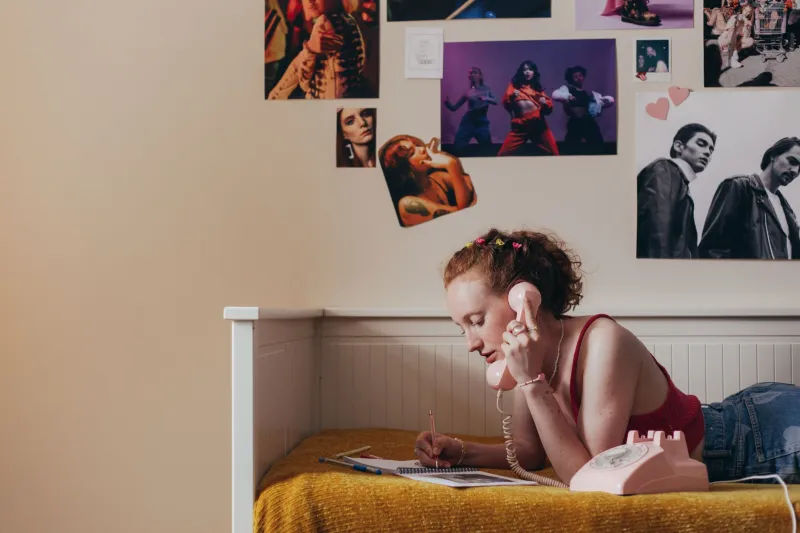
The princess phone — that sleek, compact little number that sat on your nightstand — was practically a rite of passage for American teenagers by the late seventies. Having your own line, or at least your own extension, meant freedom. It meant you could talk to whoever you wanted without your mom picking up in the other room and asking who it was.
Then there were the genuinely fancy options. Novelty phones shaped like footballs or cartoon characters. Designer sets from companies trying to class up the concept. Some households even had two lines, which in 1979 was the rough equivalent of rolling up in a Tesla today. The phone you owned said something about you, and people paid attention.
Coordinating the Chaos
Here's something younger generations might not fully appreciate: organizing a group hangout in 1979 required genuine effort and a fair amount of faith in other people. You couldn't fire off a mass text. You couldn't create a group chat and drop a pin. You had to call each person, individually, explain the plan, hope they were home, hope their line wasn't busy, and then trust that the information chain held together by the time Saturday rolled around.
Busy signals were a real obstacle. You'd dial, get that sharp repeating tone, hang up, wait a few minutes, and try again. Sometimes you'd do this four or five times. Occasionally, you'd just give up and assume they'd figure it out. Party planning was an exercise in persistence and optimism.
And then there was the shared family line problem. You'd pick up to make a call and your brother would already be on there, talking to someone about nothing important. Negotiations would follow. Timers would be set. Deals would be struck. The telephone, in a household of three or four people, was a shared resource that required actual diplomacy to manage.
The Late-Night Call and the Art of the Conversation
What the landline era produced — almost by accident — was a generation of genuinely skilled conversationalists. When the phone was your only real-time connection to someone outside your house, you learned how to talk. Not text. Not react with emojis. Talk.
Late-night phone calls in 1979 had a particular texture to them. The house would go quiet, everyone else would be asleep, and you'd be curled up with the receiver, talking in a low voice about everything and nothing. Music playing softly in the background. The hum of the refrigerator down the hall. Those conversations could go two, three hours without either person noticing the time.
There was an intimacy to it that's genuinely hard to replicate now. You couldn't multitask. You couldn't be half-present while scrolling through something else. The phone demanded your full attention, and in return it gave you a connection that felt real and immediate in a way that a lot of modern communication doesn't.
Conference Calls Before Conference Calls Were a Thing
Here's a fun wrinkle most people forget: three-way calling existed in 1979, at least in certain markets and for customers who'd paid for the feature through their local Bell operator. It wasn't universal, and it wasn't cheap, but it was out there — and the people who had it used it like a superpower.
Getting three people on a call at once felt genuinely futuristic. You could plan the whole night's logistics in one shot, mediate a disagreement between friends, or just create the earliest known version of a group chat. It was clunky and occasionally someone would accidentally hang up the whole thing, but it was a preview of a connected world that was still decades away from fully arriving.
For most people, though, the conference call was a daydream. You worked with what you had: a single line, a patient ear, and the willingness to dial the same number six times if that's what it took.
The Phone and the Party
Discos ran on music, sure. But they ran on plans first, and plans ran on the telephone. The social ecosystem of 1979 — the who's going where, the what time should we meet, the did you hear what happened last weekend — all of it flowed through those handsets.
There's something almost beautifully analog about that. Every social event required a real investment of time and communication before it even started. You earned your Friday night. You had to want it badly enough to actually call people about it.
And when something went sideways — when the plans changed, when someone got lost, when the venue switched at the last minute — there was no fixing it in real time. You just hoped for the best and dealt with whatever happened when you got there. Which, weirdly, made everything feel a little more like an adventure.
Why It Still Hits
There's a reason people get genuinely wistful talking about the landline era. It's not just nostalgia for the hardware — though those avocado-green wall units do have a certain charm. It's nostalgia for the pace of it. For the way connection required intention. For the conversations that had a beginning, middle, and end because you eventually had to hang up.
In 1979, the telephone was the most important object in your house that wasn't the television. It was your lifeline, your social calendar, your gossip pipeline, and sometimes your therapist. It did all of that on a copper wire and a rotary dial, and it did it with a kind of no-frills reliability that most modern tech can't match.
So the next time you're buried under forty-seven unread notifications, take a second to think about what it felt like to pick up a receiver, dial seven digits, and just talk to someone. No read receipts. No typing indicators. Just a voice on the other end of the line and a conversation that was entirely yours.
That was 1979. And honestly, it sounds pretty good.