Your Hair Was Talking Before You Even Opened Your Mouth: The Politics of 1979 Hairstyles
Picture this: you're walking into a house party somewhere in suburban Ohio in the fall of 1979. Before anyone says hello, before the first sip of Tab or Schlitz, the room has already sized you up. Not by your shoes. Not by your jacket. By your hair.
Because in 1979, hair wasn't decoration. It was a declaration.
The styles that defined that year — feathered and flipped, Afro-puffed and proud, spiked and dyed into something that looked structurally impossible — weren't random fashion choices. They were cultural shorthand. A coded language that told the world which tribe you belonged to, what records were on your turntable, and whether you were likely to start an argument about disco at the dinner table.
Let's break it down.
The Feathered Wave: America's Most Beloved Style Statement
If there was one look that came to define mainstream 1979 America, it was the feathered flip. Think Farrah Fawcett — though she'd actually debuted that iconic poster back in '76, by 1979 the style had fully migrated from Hollywood into every mall, every high school cafeteria, every roller rink in the country.
The feathered look required commitment. You needed the right cut, the right round brush, and — critically — the right amount of Aqua Net. It swept back from the face in two symmetrical wings that, when done correctly, barely moved in a light breeze. When done incorrectly, it looked like you'd stuck your head out of a moving Camaro. (Sometimes that was also the goal.)
What did it signal? Broadly speaking: you were approachable. You listened to Fleetwood Mac and maybe some Eagles. You were probably from somewhere with a good mall. The feathered look was aspirational middle America — the hair equivalent of a shag carpet and a macramé owl on the wall.
The Afro: Volume as Resistance
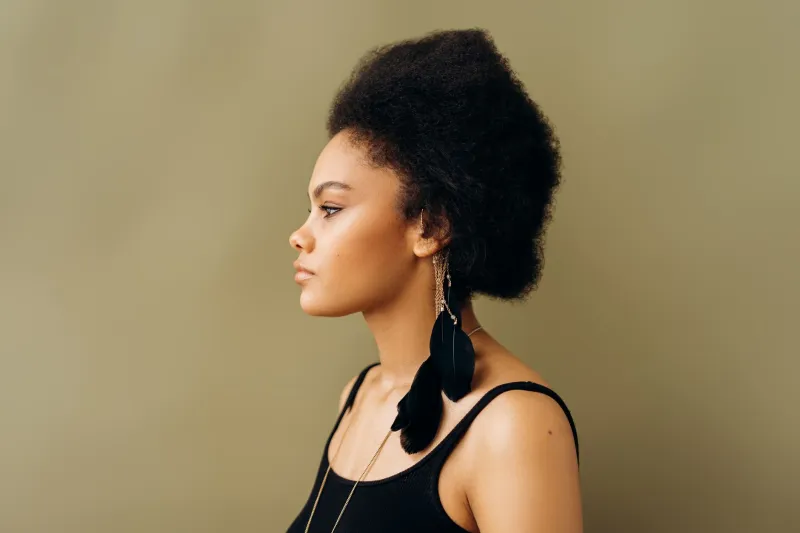
Meanwhile, across town — and across a very real cultural divide — the Afro was carrying a completely different weight. By 1979, the natural Afro had been a symbol of Black pride and political identity since the late '60s, and it hadn't lost a single inch of that meaning.
If anything, the late '70s saw the Afro evolve. Picks with fist handles. Perfectly rounded shapes that required their own kind of artistry to maintain. The style showed up everywhere from Parliament-Funkadelic album art to the basketball court to the barbershop wall, and it meant something specific: I know who I am, and I'm not shrinking for anyone.
The Afro also existed in tension with the era's other dominant Black hairstyle — the Jheri curl, which was just starting to creep into popularity by decade's end. The choice between the two wasn't just aesthetic. It was generational. It was political. It was personal in ways that outsiders rarely fully grasped.
The Punk Spike: Hair as Hostility
On the complete opposite end of the spectrum — geographically, sonically, and philosophically — the punk spike was doing its best to make everyone in the room uncomfortable, and that was entirely the point.
The punk scene that had exploded in the UK was crashing into American cities by 1979, and the hair came with it. Mohawks. Spikes shellacked into rigid points with everything from hairspray to Elmer's glue. Colors that didn't exist in nature. Shaved patches. Asymmetrical cuts that looked like they'd been done with a pair of kitchen scissors at 2 a.m. — because they had been.
This was hair as aggression. Hair as a middle finger to the feathered mainstream. If the Farrah flip said "I shop at Sears," the punk spike said "I want to watch Sears burn." It was confrontational by design, and in smaller towns especially, it could genuinely get you in trouble — at school, at work, with your parents, occasionally with strangers on the street.
The Regional Divide Nobody Talks About
Here's what the nostalgia reels tend to gloss over: 1979 hair wasn't uniform across the country. It was deeply, fascinatingly regional.
In New York and LA, punk and disco aesthetics were bleeding into each other in weird, interesting ways. In the South, big hair was already becoming its own distinct category — taller, lacquered harder, with a kind of architectural ambition that would eventually evolve into the '80s country-club look. In the Midwest, the feathered flip reigned supreme well into the early '80s. And in college towns everywhere, the shaggy, unkempt look of the singer-songwriter set said: I'm too cool to try.
Your hair told people what radio station you listened to. It told them which side of the tracks you grew up on. In some cities, it could tell them what block you lived on.
The Aerosol Elephant in the Room
Now, here's the part that Gen Z's current obsession with '70s aesthetics tends to quietly skip over: all of this required an absolutely staggering amount of aerosol hairspray.
Aqua Net. Rave. Suave. These weren't grooming products — they were industrial solvents applied to human heads multiple times a day. The chlorofluorocarbons (CFCs) in aerosol cans were, as scientists were beginning to loudly warn by the late '70s, punching holes in the ozone layer. The 1978 US ban on CFCs in certain aerosol products helped, but hairspray largely kept its chemical cocktail for years afterward.
When you see a TikTok celebrating the '70s aesthetic with a vintage Aqua Net can as a prop, just know: that little can was part of a global environmental crisis. The hair was gorgeous. The atmospheric damage was not.
Why It All Still Matters
The reason 1979 hair is worth revisiting isn't just nostalgia, though there's plenty of that to go around. It's that the year represented a genuine moment when personal appearance was genuinely political in a way that feels surprisingly modern.
The feathered flip vs. the punk spike vs. the Afro vs. the disco-sleek look — these weren't just different styles coexisting peacefully. They were arguments. They were competing visions of what America was, who got to be cool, and what the next decade was going to look like.
In a lot of ways, the hairspray wars of 1979 were a preview of the culture wars that would define the '80s. The sides were forming. The positions were hardening. And everybody's hair was holding its shape, whether they liked it or not.
So next time you see someone rocking a vintage-inspired feathered flip or a carefully reconstructed '70s Afro pick in their bathroom selfie, remember: they're not just wearing a hairstyle. They're wearing a piece of a very loud, very complicated, very aerosol-scented argument that started almost fifty years ago and, honestly, never really ended.