Two AA Batteries and Total Freedom: The Sony Walkman Turns 45 and It Still Hits Different
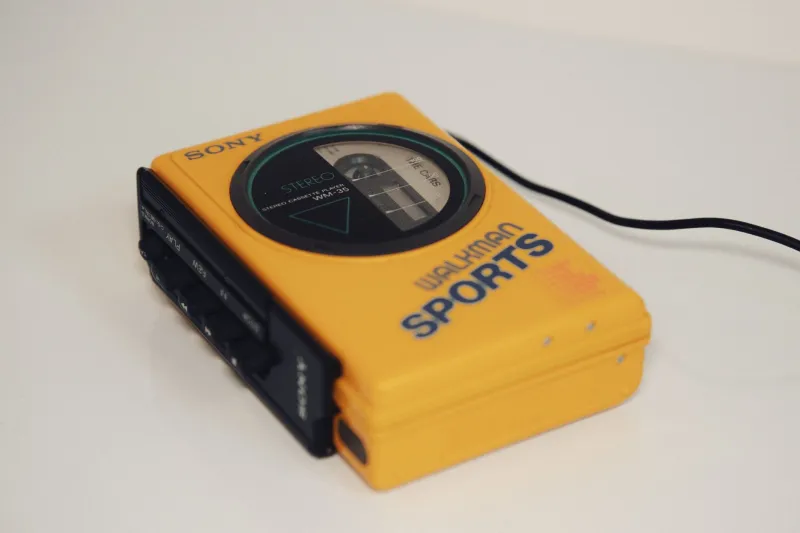
Picture this: it's 1979. You want to listen to music. Your options are your living room stereo, your car radio, or a transistor radio with tinny speakers and zero bass. Music was, fundamentally, a stationary experience — something that happened in a place, not something you carried with you like a companion.
Then Sony shipped the TPS-L2, and everything changed.
The original Walkman hit Japanese shelves in July 1979 and arrived in the United States shortly after, carrying a price tag of around $150 — which, adjusted for inflation, is roughly $600 today. Sony's internal projections were modest: maybe 5,000 units a month. They sold 30,000 in the first two months. By the mid-1980s, over 50 million units had found their way into the hands, pockets, and gym bags of people around the world. The Walkman wasn't just a product. It was a paradigm shift wearing foam headphones.
The Idea That Seemed Crazy Until It Wasn't
The origin story of the Walkman has become the stuff of business school legend. Sony co-founder Masaru Ibuka wanted a way to listen to music on his frequent long-haul flights without disturbing the people around him. He asked Sony's engineers to take an existing portable tape recorder, strip out the recording function, add a headphone jack, and make it small enough to clip to a belt. The engineers thought it was a novelty. Ibuka's co-founder Akio Morita thought it was a revolution.
Morita was right. What he understood — and what the skeptics missed — was that people weren't just hungry for portable music. They were hungry for private music. The headphones weren't just a delivery mechanism; they were a declaration. When you put on those foam-padded Sonys and pressed play, you were stepping into your own sonic world, sealed off from the noise of the bus, the office, the street. You became the director of your own personal movie, and the soundtrack was entirely your call.
In 1979 America, that kind of individual autonomy felt genuinely radical. The country was coming off a decade of collective trauma — Vietnam, Watergate, the energy crisis — and there was a growing cultural appetite for personal space, personal choice, personal expression. The Walkman arrived at exactly the right moment to feed that hunger.
Redesigning the Soundtrack of Everyday Life
Before the Walkman, music was communal almost by necessity. You went to a concert, you gathered around a stereo, you listened to the radio with everyone else in the car. The Walkman shattered that model. Suddenly, your morning jog had a score. Your subway commute became a private concert. The experience of walking through a city — navigating crowds, watching strangers, feeling the rhythm of urban life — could now happen in sync with whatever music moved you most.
Running culture in particular was transformed almost overnight. The jogging boom of the late 1970s had already put millions of Americans on the roads and trails, but running with music had been impractical before the Walkman. By 1980, the combination of portable music and personal fitness had become so culturally embedded that it's nearly impossible to imagine one without the other. Every person you see today running with earbuds is living out a tradition that started with a silver cassette player in 1979.
Mix tapes — those deeply personal, labor-intensive declarations of feeling — became a genuine art form in the Walkman era. Making a mix tape for someone wasn't just sharing music; it was constructing a narrative, curating an emotional experience, saying things with song selections that felt too vulnerable to say out loud. The Walkman was the device that made mix tapes matter, and the cultural weight of that practice echoes in every Spotify playlist someone shares with a crush today.
The Design Details That Still Hold Up
Here's something that surprises people when they actually handle an original TPS-L2: the thing is beautiful. Not in a precious, museum-piece way, but in the way that genuinely well-engineered objects have a rightness to them that transcends era. The brushed aluminum housing, the satisfying click of the play button, the clean simplicity of the interface — Sony's designers understood that the device needed to feel like an object worth caring about.
There was also that quirky two-headphone jack configuration on the original model, which Sony included so you could share the listening experience with a friend. It's a charming detail that speaks to an era before personal technology was assumed to be fundamentally solitary. Later models dropped the second jack, but that original design choice tells you something about the ambivalence Sony felt about the device's isolating potential.
The auto-reverse mechanism that appeared in later Walkman models was another small engineering triumph — no more fumbling to flip the cassette at the end of Side A while you're trying to keep your running pace. These incremental improvements, rolled out across hundreds of model variations through the 1980s and 1990s, kept the platform relevant and kept consumers coming back.
The Collectors Who Never Stopped Caring
Walk through any significant vintage electronics fair in the US today and you'll find at least one table dedicated to Walkman hardware, and you'll find people around it who are very serious. The vintage Walkman collecting scene has grown steadily over the past decade, driven largely by Gen X enthusiasts who grew up with the devices and millennials who discovered them through thrift stores and estate sales.
Certain models command serious premiums. The WM-D6C, Sony's professional-grade Walkman from 1984, is considered by audiophiles to be one of the finest cassette playback machines ever built, and clean examples regularly sell for $300 to $500 or more. The original TPS-L2 in working condition? You're looking at four figures if it's in good shape. Even the more common consumer models from the late 1980s have developed dedicated followings among people who appreciate their particular sonic character.
Cassette tapes themselves have staged a genuine commercial comeback — vinyl's smaller, scrappier sibling. Independent artists release music on cassette as a deliberate aesthetic and economic choice. Record stores that carry tapes report steady sales to younger customers who weren't alive when cassettes were the dominant format. There's something about the warmth and slight imperfection of analog tape that digital streaming, for all its convenience, simply doesn't replicate.
Why It Still Matters in the Streaming Age
It would be easy to frame the Walkman as a charming relic, a footnote in the march from vinyl to CD to MP3 to streaming. But that framing misses the point. The Walkman didn't just change the format of music consumption — it permanently altered our expectations of what music could be in our lives.
The idea that your personal soundtrack should be available to you at all times, in all places, fully private and fully under your control — that's a Walkman idea. Every pair of wireless earbuds, every streaming subscription, every curated playlist is downstream from that orange-and-silver cassette player that Sony shipped in the summer of 1979.
We're all still walking around in the world the Walkman made. We've just upgraded the hardware.